
Stories that matter in our community
World book day in Stratford & Warwick
Introduction
I was introduced to autobiographical writing in 1997 when I began an ‘Open Studies’ Creative Writing course at Warwick University. One of the modules was devoted to ‘autobiographical Writing’.
It is said that everyone has a book inside them and a different story to tell.
Meanwhile, my Mother had been attending a family history course, also through Warwick University and had begun to research her family tree.
My Mother had kept a copy of my Granny’s handwritten diary of her time spent in America between 1914 and 1924. The original diary was written in pencil and fairly difficult to read. It was written in 1926, two years after Granny had returned to England.
In 2000, we were ready to have the diary printed, along with old photographs and letters written to Rose Helen Andrews (Granny) from her American school friends.
Autobiographical writing
I think that autobiographical writing is extremely important to civilisation and human society. If we look back in history, it is often only the lives of famous people which are documented and not the ordinary man in the street.
I wanted to write my autobiography because I was one of the first disabled children in Kenilworth to go to mainstream school. The 1981 Education Act stipulated that, where possible, disabled children should be educated in mainstream school. However, in 1981, I had already been in school for six years. I did not have any easy time at school and was expected to keep up both physically and intellectually. I did all the work and the school took the credit for what I achieved!
I wrote my book in 1988 when I was eighteen, but did not have it printed until many years later. I wrote it as a way of processing all the different things that I had gone through. I did not want my experiences to be forgotten, but I also wanted to move on with my life.
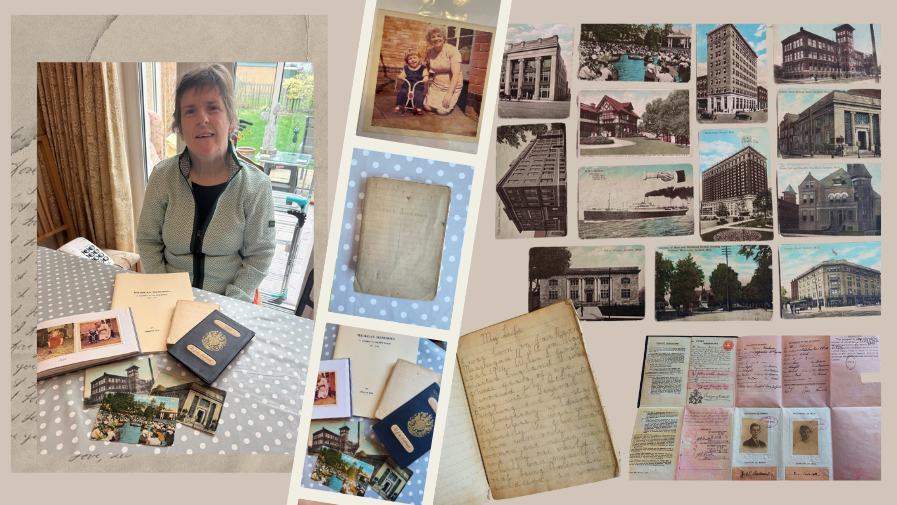
Granny’s diary
I do not remember my Granny (Rose Helen Andrews) but was always fascinated by what my Mum had told me about her early life in America. It was always a source of great amusement that she could have been sailing on the ‘Titanic' and could have been drowned, or rescued, as fate decreed.
My Mother’s family were only ordinary working-class people from Coventry, yet they decided to emigrate to America and begin a new life. Who would have the courage or resources to do this now in the modern world?
Conclusion
As well as writing and collating these two autobiographies, I have also read many biographies of famous people over the years. Most are just ordinary people who happen to be famous!
Everyone’s story is important, as Mum always said, ‘the people who wash the dishes are just as important as those who run the country!’
I am very proud of what my Granny, my Mum and myself achieved by writing and producing these books and very grateful that modern society gave us the tools and education to tell our stories.
Jill Ison.

Home care Stratford & Warwick
Every life holds a unique story worth sharing, like the pages of a book still being written. Home care in Stratford & Warwick supports people to keep living their story at home and sharing it with the people around them.
Home care services